Top 10 Fun and Educational Activities for Kids at Home
Discover 10 fun and educational activities for kids at home. From STEM projects to creative crafts, keep children engaged while building essential skills.
Finding the right balance between entertainment and education can feel like a challenge when kids are home. Whether you’re navigating school breaks, rainy days, or just looking for meaningful ways to spend time together, the good news is that learning activities for kids don’t have to feel like traditional schoolwork. The best educational activities for kids blend fun with skill development so naturally that children barely notice they’re learning.
Parents today understand that hands-on learning creates deeper connections than passive screen time. When children engage with interactive learning experiences at home, they develop critical thinking skills, creativity, and confidence. These activities also strengthen family bonds while supporting cognitive development in ways that feel organic and enjoyable.
This guide presents ten proven kids activities at home that combine educational value with genuine fun. Each activity uses common household items and requires minimal preparation, making them practical for busy families. From STEM activities that spark scientific curiosity to creative activities that nurture artistic expression, these ideas work for various ages and interests. You’ll find options for quiet afternoons, high-energy moments, and everything in between. These aren’t just time-fillers. They’re opportunities to support your child’s growth while creating memories that last well beyond childhood.
1. DIY Science Experiments with Kitchen Ingredients
Science experiments transform your kitchen into a home laboratory where children discover fundamental scientific principles through play. These STEM activities require nothing more than pantry staples, yet they deliver powerful learning moments.
Why Science Experiments Matter
When kids conduct experiments at home, they practice the scientific method without realizing it. They form hypotheses, test ideas, observe results, and draw conclusions. This process builds critical thinking skills and teaches children that failure is part of learning.
Easy Experiments to Try
Start with a classic volcano using baking soda and vinegar. Mix food coloring into the vinegar for extra visual impact. The chemical reaction demonstrates acid-base interactions while providing the excitement kids crave.
Create dancing raisins by dropping them into clear soda. The carbon dioxide bubbles attach to the raisins, causing them to rise and fall repeatedly. This simple experiment teaches about density and gas behavior.
Make invisible ink using lemon juice and a cotton swab. After writing a secret message, hold the paper near a light bulb (with supervision) to reveal the hidden text. This activity combines chemistry with imaginative play.
Learning Outcomes
These experiments develop observation skills, introduce basic chemistry concepts, and encourage curiosity about how the world works. Children learn to follow instructions, measure ingredients accurately, and record their findings.

2. Creative Arts and Crafts Projects
Arts and crafts offer more than just creative expression. They strengthen fine motor skills, teach planning and execution, and give children tangible results they can display with pride.
Building Essential Skills Through Art
When children cut, glue, fold, and paint, they develop hand-eye coordination and dexterity needed for writing. Color selection and composition teach basic design principles, while completing projects builds patience and focus.
Project Ideas That Inspire
Make nature collages using leaves, twigs, and flowers collected during walks. Children arrange these materials on cardboard, creating unique artwork that connects them with the outdoors.
Create sock puppets using old socks, buttons, yarn, and fabric scraps. After making their puppets, kids can write and perform stories, combining craft with storytelling and drama.
Try salt dough sculptures as a hands-on medium. Mix flour, salt, and water to create moldable dough that hardens when baked. Children can paint their finished creations, making personalized decorations or gifts.
Build cardboard cities from recycled boxes. This large-scale project encourages spatial reasoning and imaginative play as children design buildings, roads, and parks for their miniature world.
What Children Gain
Art projects teach children that multiple solutions exist for creative challenges. They learn to plan ahead, problem-solve when things don’t work as expected, and take pride in their accomplishments.
3. Math Games That Make Numbers Fun
Making math engaging at home removes the pressure children often feel in classroom settings. Math games disguise skill-building as play, helping kids develop number sense naturally.
Turning Everyday Items Into Math Tools
Use household objects to create concrete learning experiences. Count buttons or pasta pieces, sort coins by value, or measure ingredients while cooking together.
Interactive Math Activities
Play store using play money or real coins (under supervision). Children practice addition, subtraction, and making change while role-playing as shopkeepers and customers. This activity connects math to real-world situations they encounter regularly.
Create pattern bracelets using colored beads. Children identify, extend, and create patterns, developing sequencing skills essential for mathematical thinking. They can wear their finished bracelets, making learning visible and rewarding.
Build shape towers using marshmallows and toothpicks. Construct 2D shapes first, then progress to 3D structures like cubes and pyramids. This hands-on learning approach makes geometry tangible and fun.
Play “number hunt” where children find and photograph numbers around the house. Clocks, addresses, product labels, and measurements all become part of the game, showing math’s presence in daily life.
Mathematical Benefits
These activities develop number recognition, counting skills, basic operations, and spatial reasoning. Children learn that math exists beyond worksheets and applies to situations they care about.
4. Reading and Literacy Adventures
Building reading skills doesn’t require formal lessons. Literacy activities that feel like games encourage children to engage with letters, words, and stories enthusiastically.
Creating a Print-Rich Environment
Surround children with varied reading materials: picture books, chapter books, magazines, comics, and even cereal boxes. When print is everywhere, reading becomes a natural part of daily life.
Engaging Literacy Activities
Start a family book club where everyone reads the same book and discusses it over snacks. Even young children can participate by sharing their favorite parts or predicting what might happen next.
Play alphabet scavenger hunts where children find objects starting with specific letters. This game reinforces letter-sound relationships while encouraging observation and movement.
Create story stones by drawing simple images on smooth rocks. Children draw stones from a bag and weave them into original stories, developing narrative skills and imagination simultaneously.
Make homemade books where children write and illustrate their own stories. Staple paper together to form a book, and let kids fill pages with their ideas. This activity connects reading with writing and authorship.
According to reading specialists at Education.com, hands-on literacy activities significantly improve reading comprehension and vocabulary development in young learners.
Literacy Development
These activities build phonemic awareness, vocabulary, comprehension, and storytelling skills. Children discover that reading and writing are tools for sharing ideas and exploring imaginations.
5. Indoor Obstacle Courses for Active Learning
Physical activity supports brain development and learning retention. Indoor activities that combine movement with challenges keep children engaged during learning at home sessions.
Why Movement Matters
Exercise increases blood flow to the brain, improving focus and memory. When children move while learning, they often retain information better than through sedentary study alone.
Obstacle Course Ideas
Use pillows, cushions, and furniture to create jumping stations, crawling tunnels, and balance beams. Children navigate the course while following instructions like “hop on one foot” or “crawl backward.”
Add educational elements by placing flashcards at each station. Children must answer a math problem or read a word before moving to the next challenge, combining physical activity with academic practice.
Create timed challenges where children race against the clock or try to beat their previous scores. This introduces measurement concepts and personal goal-setting.
Include fine motor stations where children must complete tasks like building a block tower or threading beads before continuing through the course.
Physical and Cognitive Benefits
Obstacle courses develop gross motor skills, coordination, balance, and spatial awareness. They also teach following multi-step directions, sequencing, and persistence through challenging tasks.
6. Cooking and Baking as Life Skills Education
The kitchen offers endless opportunities for educational activities at home. Cooking teaches math, science, reading, and practical life skills simultaneously.
Learning Through Food Preparation
Cooking requires children to read recipes, measure ingredients, observe chemical changes, and practice safety. These real-world applications make abstract concepts concrete and relevant.
Kitchen Activities for All Ages
Younger children can help wash vegetables, tear lettuce, or stir ingredients. These simple tasks build confidence and teach them to contribute to family life.
Elementary-age kids can follow simple recipes for smoothies, sandwiches, or no-bake treats. Reading recipes strengthens sequencing skills and following written directions.
Try baking projects that demonstrate scientific principles. Watch yeast activate in warm water, observe how baking soda creates rise in muffins, or see how heat transforms raw ingredients into finished dishes.
Create “cooking math” challenges where children double or halve recipes, practicing multiplication and division with real consequences they can taste.
Comprehensive Skill Building
Cooking develops measurement skills, fraction understanding, reading comprehension, time management, and patience. Children also learn about nutrition, food safety, and cultural traditions through family recipes.
7. Nature Exploration and Outdoor Discovery
Even a small backyard or neighborhood park becomes an outdoor classroom when children approach it with curiosity. Nature-based learning connects kids with their environment while teaching science concepts.
Benefits of Outdoor Learning
Time in nature reduces stress, improves attention spans, and encourages physical activity. Children who regularly explore outdoors develop stronger observational skills and environmental awareness.
Outdoor Activity Ideas
Start a nature journal where children draw or write about what they observe. Note weather patterns, seasonal changes, animal behavior, and plant growth over time.
Create a backyard scavenger hunt with specific items to find: something smooth, something green, something smaller than your thumb. This activity sharpens observation skills and introduces descriptive language.
Plant a small garden, even if just herbs in pots. Children learn about plant life cycles, responsibility through daily watering, and patience as they wait for growth.
Collect natural materials for art projects or science observations. Pine cones, interesting rocks, leaves, and sticks become tools for learning about classification, patterns, and ecosystems.
Environmental and Scientific Understanding
These activities teach biology, ecology, seasons, weather, and life cycles. Children develop respect for nature and understand their role in protecting the environment.
8. Music and Rhythm Activities
Musical experiences support brain development in profound ways. Music education at home doesn’t require instruments or formal training, just creativity and enthusiasm.
How Music Enhances Learning
Music strengthens memory, improves language skills, and teaches mathematical concepts like patterns and fractions. It also offers emotional expression and cultural connection.
Musical Activities to Try
Create homemade instruments using household items. Stretch rubber bands over empty tissue boxes for guitars, fill containers with rice or beans for shakers, or tap pots and pans as drums.
Play rhythm games where you clap a pattern and children repeat it. Start simple and gradually increase complexity, building auditory processing skills.
Have family dance parties with varied music genres. Discuss how different styles make you feel and move, introducing children to cultural diversity through music.
Learn simple songs together, especially ones with actions or hand motions. Songs with repetitive lyrics build memory and language skills naturally.
Musical and Cognitive Development
Music activities enhance listening skills, pattern recognition, coordination, self-expression, and cultural awareness. They also provide joyful family bonding experiences.
9. Building and Construction Play
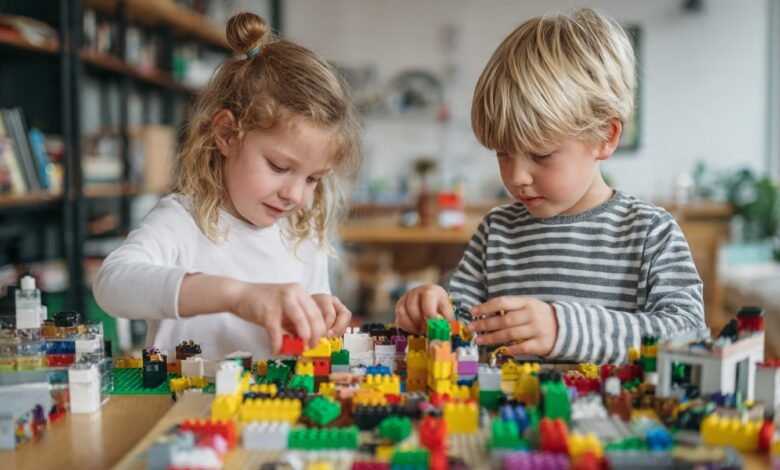
Construction activities using blocks, LEGOs, or cardboard teach engineering principles, spatial reasoning, and creative problem-solving.
The Power of Building
When children construct, they experiment with balance, symmetry, and stability. They learn through trial and error, developing resilience when structures topple and require rebuilding.
Construction Project Ideas
Challenge children to build the tallest tower possible using specific materials. This introduces concepts of structural integrity and creative constraint.
Create themed building projects: design a bridge that can hold a toy car, construct a house for a stuffed animal, or build a marble run using cardboard tubes.
Use blueprints or pictures as inspiration, teaching children to follow plans and visualize three-dimensional objects from two-dimensional drawings.
Encourage free building where children create without specific instructions. This open-ended play fosters imagination and original thinking.
Engineering and Mathematical Skills
Building activities develop spatial awareness, geometry understanding, physics concepts, planning abilities, and fine motor precision. Children learn that mistakes lead to improvements and solutions.
10. Dramatic Play and Role-Playing
Pretend play might look simple, but it’s actually complex cognitive work. Dramatic play helps children process experiences, develop empathy, and practice social skills.
Why Pretend Play Matters
When children role-play, they experiment with different perspectives, practice conversation skills, and work through emotions in safe contexts. This type of play supports social-emotional development crucial for school success.
Role-Playing Activity Ideas
Set up a home restaurant where children take orders, prepare pretend food, and serve family members. This scenario teaches customer service, sequencing, and basic math through menu pricing.
Create a doctor’s office or veterinary clinic using stuffed animals as patients. Children practice empathy, learn medical vocabulary, and work through any healthcare anxieties.
Establish a home post office where kids sort mail, sell stamps, and deliver letters to different rooms. This activity teaches organization, reading addresses, and community helper roles.
Encourage school play where children teach their toys or siblings. This reinforces their own learning while developing leadership and communication skills.
Experts at UNICEF emphasize that play-based learning activities significantly support children’s cognitive and social development during early childhood.
Social and Emotional Growth
Dramatic play develops imagination, empathy, language skills, problem-solving abilities, and cooperation. Children learn to negotiate roles, share space, and navigate social situations through pretend scenarios.
Making Educational Activities Part of Daily Life
The most effective educational activities for kids don’t feel like forced learning sessions. They emerge naturally from curiosity, availability of materials, and family routines. Keep basic supplies accessible: paper, crayons, building materials, books, and craft items. When children can independently access these resources, they initiate their own learning adventures. Rotate available activities to maintain interest without overwhelming kids with too many choices simultaneously. Balance structured activities with free play time where children direct their own learning and creativity. Some days call for STEM activities with clear learning goals, while other days benefit from unstructured exploration. Follow your child’s lead and energy levels. These kids activities at home work best when they match your child’s developmental stage and interests. A preschooler might spend ten minutes on an activity that captivates an elementary student for an hour. Respect these differences and adjust expectations accordingly. The goal isn’t perfection or completing every activity perfectly but rather fostering curiosity, building skills gradually, and creating positive associations with learning. When children enjoy learning at home, they develop intrinsic motivation that serves them throughout their educational journey and beyond.